
The purpose of this article is simple: to help you see the beauty of God’s plan. God’s Holy Days are not random dates on an ancient calendar. They are appointed times—built into creation (Genesis 1:14), taught throughout Scripture, and fulfilled in Jesus the Messiah. When we slow down and examine the timing, we find something that strengthens faith: the events of Jesus’ death and resurrection align with God’s appointments in a way that is both meaningful and deeply reassuring.
And there is a practical reason this matters. Christians are called to be ready—to know what the Scriptures say and to be prepared to give an answer for the hope within them. If someone asks about Jesus’ own sign—three days and three nights—and we only know the “Good Friday to Sunday” tradition, we can stumble. A skeptic may even accuse Jesus of speaking falsely. But when we follow the Bible’s timing carefully, the picture becomes clear, coherent, and beautiful.
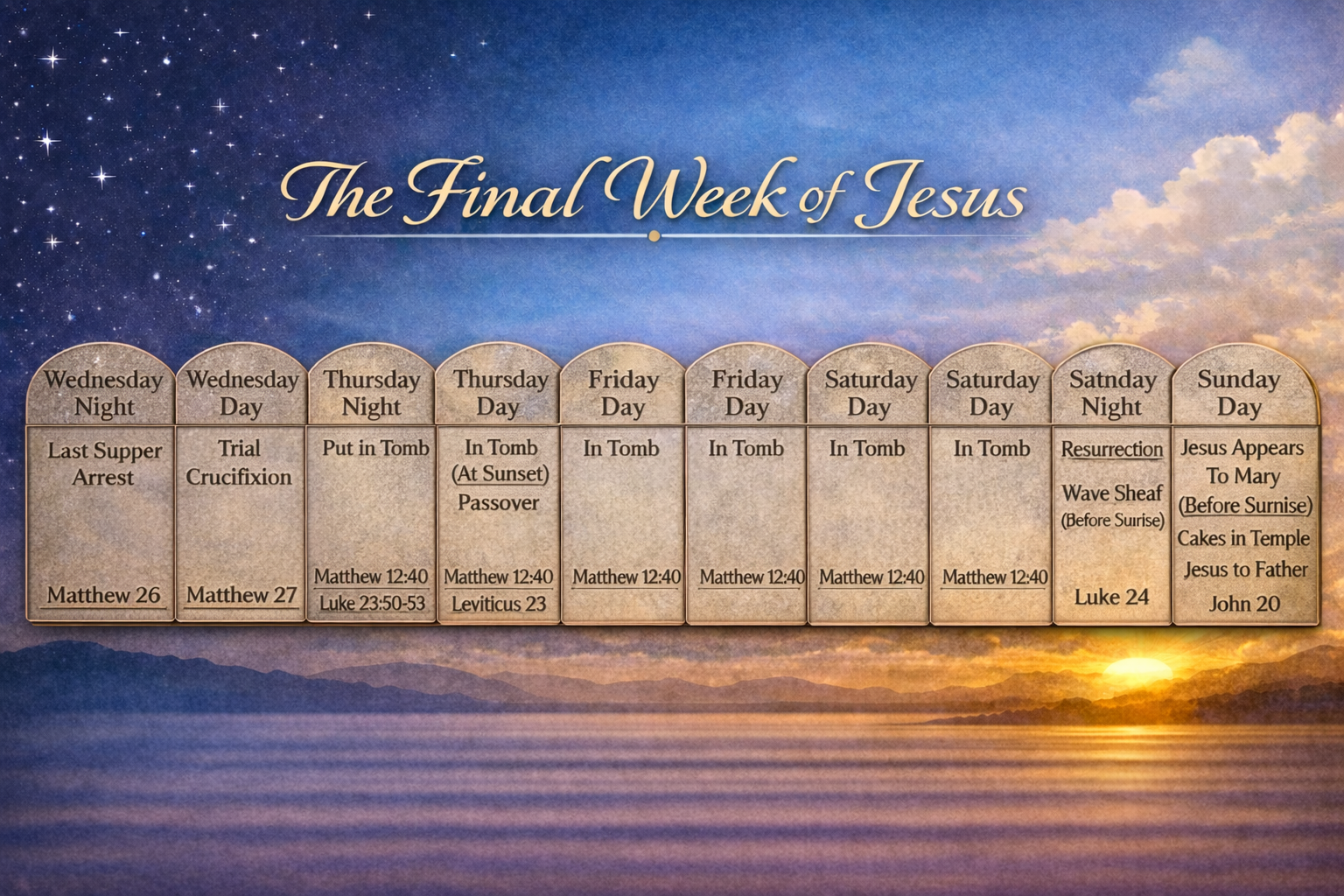
A note about “days” and “nights” in Jesus’ time
In the biblical world, the day transitions at sunset. The rhythm is: sunset → night → daytime → sunset. So what we might call “Wednesday night” after dinner would already be moving into the next day’s night portion. In simple terms: at sunset on Wednesday, it becomes “Thursday night,” followed by Thursday day, then Friday night and Friday day, and so on. This matters when we read the Gospel accounts and when we talk about “three days and three nights.”
The timeline of the Passion week (as presented here)
Below is the sequence you provided, presented as a simple timeline.
- Wednesday NightThe Last Supper (the Lord’s Supper).
- Wednesday NightJesus Arrested in the garden.
- Wednesday DayJesus Trial.
- Wednesday DayJesus’ Sacrifice—the crucifixion.
- Before SunsetJesus’ Death before the day ends.
- At SunsetPlaced in the Tomb as Wednesday turns to Thursday Night.
- Three Days & NightsIn the tomb for a complete three days and three nights: Thursday Night, Thursday; Friday Night, Friday; Saturday Night, Saturday.
- At SunsetResurrection exactly as the day changes from Saturday to Sunday Night—coinciding with the ancient Wave Sheaf (Firstfruits) Offering.
- Before SunriseJesus appears to Mary while it is still “Sunday night” moving toward Sunday day.
Why the hurry to place Jesus in the tomb?
The Gospels emphasize urgency: Jesus must be buried before sunset. Many assume the reason is only the weekly Saturday Sabbath. But Scripture also describes an annual Sabbath: the First Day of Unleavened Bread—a Holy Day Sabbath found in Leviticus 23. In this understanding, the urgency makes sense: the annual Holy Day Sabbath was approaching at sunset.
“Three days and three nights”—complete, not partial
Jesus points to a specific sign: “three days and three nights” (Matthew 12:40). This article is not trying to win an argument—it is inviting you to read the text carefully. If Jesus meant a complete three days and three nights, then the timing should reflect that completeness. When we align the burial at sunset and the resurrection at the next sunset three days later, the prophecy fits naturally.
Wave Sheaf (Firstfruits): the timing is stunning
In the ancient practice, the firstfruits (barley) were harvested right after the Sabbath ended—at sunset moving into the next day. The firstfruits were then prepared and presented the following morning. In this pattern, Jesus rises at sunset as the Sabbath ends—at the moment the firstfruits are gathered—then later is “presented” to the Father, matching the firstfruits presentation.
This also illuminates Jesus’ words to Mary: “Do not cling to me… I have not yet ascended to the Father” (John 20:17). In this view, Jesus had risen, but the “presentation” had not yet occurred—again aligning with the firstfruits pattern.
Passover and “a night to be remembered”
The night Jesus shared bread and cup with His disciples can be called the Christ Passover, but it occurs a day before the original Passover night. That original Passover is tied to redemption and remembrance—“a night to be remembered” in the Exodus story—and in this understanding, the burial timing echoes that deliverance theme.
The takeaway: God’s plan is beautiful—and strengthening
God set appointed times from the beginning. Jesus does not merely “fit into” that story—He fulfills it. When we see the timeline with biblical day-counting and with the Holy Days in view, we don’t lose Jesus—we see Him more clearly. And we gain confidence: the Scriptures are coherent, and the Messiah’s sign stands firm.
The goal is to help believers be prepared—so that when questions come, our faith is strengthened, not shaken. The hope within us is worth understanding.
To God be all the glory.